If you’re self-employed in British Columbia, you already know that running your own business comes with a trade-off: more freedom, but also more paperwork headaches when it’s time to prove your income to a lender. Whether you’re a contractor, a consultant, a sole proprietor, a partner, or the majority shareholder of your own incorporated company, getting approved for a self-employed mortgage in BC often looks nothing like the process your salaried friends go through.
The good news is that self-employed borrowers get approved for mortgages every single day in BC. The key is understanding how lenders actually look at your income, what documents they’ll want, and which programs exist specifically for people in your situation. This guide walks through everything you need to know before you apply.
Why Getting a Mortgage Can Be Different When You’re Self-Employed
Traditional mortgage underwriting was built around a simple assumption: a borrower has an employer, a T4, and a predictable paycheque. When that’s not your reality, lenders have to work a little harder to figure out what your income actually looks like, and so do you.
Self-employed Canadians often write off legitimate business expenses to reduce their taxable income. That’s smart tax planning, but it creates a problem at mortgage time. If your Notice of Assessment shows a net income of $45,000 because you claimed every deduction available to you, a lender using traditional income verification may only qualify you based on that number, even if your business actually generates significantly more in revenue.
This is the core tension for self-employed borrowers: the tax strategy that saves you money in April can work against you when you’re trying to qualify for a mortgage. That doesn’t mean you’re out of luck. It means you need a lender and a mortgage strategy that account for how self-employed income really works.
Other differences self-employed borrowers commonly run into include:
- Lenders wanting to see a longer income history (often two years) to establish a trend
- More scrutiny on business stability, industry, and structure (sole proprietor vs. incorporated)
- Potentially higher down payment requirements depending on the program
- A need to explain fluctuations in year-over-year income
- More documentation requests than a typical salaried applicant would face
None of this means self-employed borrowers are seen as “riskier” across the board. It just means the qualification process is different, and it pays to understand it before you start house hunting.
What Is a Business-for-Self (BFS) Mortgage?
You may hear your mortgage broker refer to a Business-for-Self (BFS) mortgage, sometimes shortened to a BFS mortgage. This isn’t a separate type of mortgage product so much as a category of underwriting approach designed for borrowers whose income doesn’t come from a T4 employer.
BFS mortgage programs exist because lenders recognize that a strict “line 15000 on your tax return” approach doesn’t fairly represent many business owners’ true earning capacity. Under a BFS approach, a lender may consider:
- Your business’s gross revenue, not just your personal net income
- Add-backs for legitimate business expenses that reduce taxable income but don’t reduce actual cash flow
- Stated income, supported by reasonability tests for your industry
- A combination of personal and business financial documentation
BFS programs are offered by many traditional lenders as well as alternative and private lenders. Some can be insured (through mortgage default insurers), which affects the down payment and rate you’ll be offered. A mortgage broker who regularly works with self-employed clients can tell you which BFS programs are currently available and which lenders are the best fit for your specific business structure.
How Lenders Calculate Self-Employed Income
This is where things get technical, and where working with an experienced mortgage broker really pays off. Lenders don’t all calculate self-employed income the same way, and the method used can dramatically change how much you qualify for.
Stated Income vs. Traditional Income Verification
There are generally two paths self-employed borrowers can take:
Traditional income verification uses your actual, documented net income as reported on your Notices of Assessment and tax returns (usually averaged over two years). This is straightforward if your declared income is high enough to support the mortgage you want, and it tends to come with access to the most competitive rates.
Stated income programs (a hallmark of BFS lending) allow you to declare an income that’s reasonable for your business type, revenue, and industry, even if it’s higher than what shows up on your tax return. Lenders will typically want to see that the stated amount is plausible given your business revenue, and they’ll often require a higher down payment and may charge a modestly higher rate to offset the added risk of not fully verifying income through traditional means.
Which route makes sense depends on your numbers, your down payment, and your goals. Some borrowers are better off doing a couple of years of stronger tax filings before applying; others are better served by a stated income approach right now. This is exactly the kind of decision a mortgage strategy call is designed to sort out.
Gross Business Revenue
For some self-employed borrowers, particularly those running a business with strong top-line revenue but heavy reinvestment or expense claims, lenders may consider gross business revenue rather than net personal income. This is more common with certain BFS and alternative lending programs, and it can be a game-changer for business owners whose net self-employed income doesn’t reflect how healthy their business actually is.
Add-Backs and Business Expenses
Many self-employed borrowers write off expenses like vehicle costs, home office deductions, meals, and capital cost allowance (depreciation). Some of these are genuine cash outflows; others, like capital cost allowance, don’t actually reduce the cash available to you. Lenders who allow add-backs will add certain non-cash or discretionary deductions back to your net income to arrive at a more accurate picture of what you can actually afford. Not every lender allows the same add-backs, so this is another area where lender selection matters.
What Documents Will You Need?
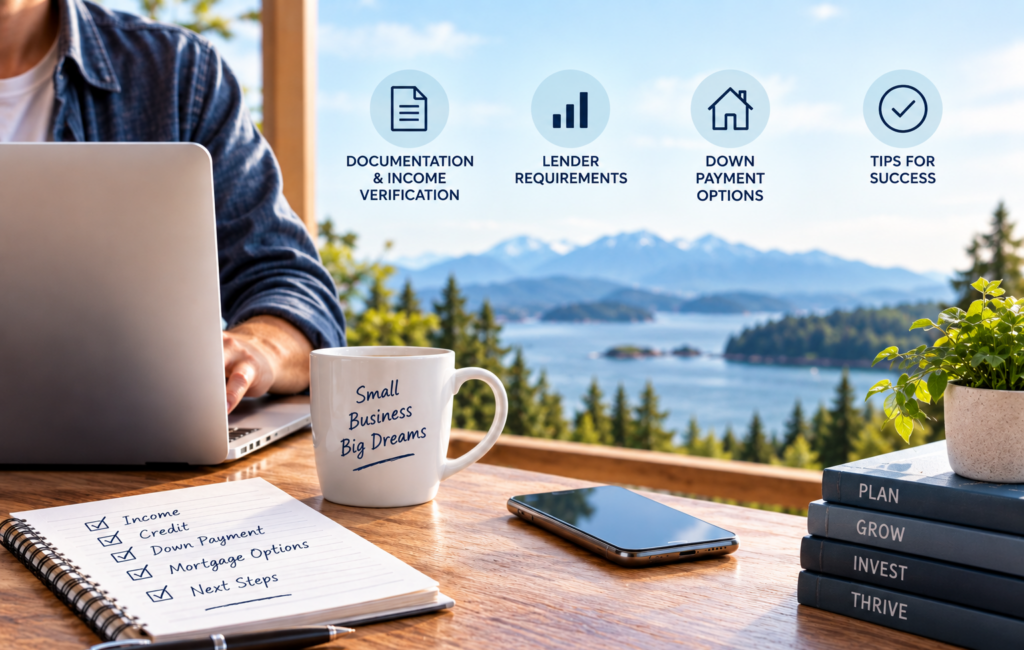
Self-employed applicants should expect to provide more documentation than a salaried employee typically would. While requirements vary by lender and program, a well-prepared self-employed borrower usually has the following ready:
- Two years of personal tax returns (T1 Generals) with all schedules including the T2125 – Statement of Business and Professional Activities
- Two years of Notices of Assessment (NOAs), showing no outstanding balances owed to CRA
- Proof of business ownership (Articles of Incorporation, central security register, business licence, or GST Registration number)
- Financial statements for incorporated businesses
- GST/HST filings, if applicable
- Business or personal bank statements showing transactions for the business and down payment funds, often 6-12 months
- A letter from your accountant confirming your business structure, ownership percentage, and income, in some cases
- Contracts, invoices, receipts, or proof of ongoing work for contractors and consultants
Because this list is longer and more varied than what a T4 employee provides, it’s worth starting to gather these documents well before you plan to submit an offer on a home. Lenders move faster, and often offer better terms, when a file is complete and organized from the start.
What If You Minimize Your Taxable Income?
This is one of the most common concerns self-employed borrowers bring to their first conversation with a mortgage broker: “My accountant has me writing off as much as possible, will that hurt my mortgage application?”
It can, if you go the traditional income verification route, since your qualifying income will be based largely on what’s reported on your tax return. But there are several ways around this:
- BFS and stated income programs allow lenders to look beyond your net taxable income to a more realistic picture of your earning capacity.
- Add-backs or gross-up of net self-employed income may restore some of your write-offs to your qualifying income.
- A larger down payment can offset a lower stated or verified income, since it reduces the loan-to-value ratio and the lender’s risk.
- Adjusting your tax strategy a year or two before applying is sometimes the right move if you’re planning a purchase in the near future, this is a conversation to have with both your accountant and your mortgage broker together.
There’s no single right answer here, and the best approach depends on your timeline, your business structure, and how much flexibility you have with your accountant. What matters most is having this conversation early, ideally before your accountant finalizes another year of tax filings that could affect what you qualify for.
Traditional Lenders vs. Alternative Lenders
Self-employed borrowers in BC generally have three broad categories of lenders to consider:
A-lenders (banks, credit unions, and monoline lenders) offer the best rates and terms, but typically require stronger documented income, solid credit, and a track record of at least two years of self-employment. Many now offer BFS programs specifically designed for stronger self-employed applicants.
B-lenders (alternative and A-lender alternative programs) are often more flexible on income verification, credit history, and business structure. They may accept stated income more readily but usually require a larger down payment and come with modestly higher interest rates and sometimes lender fees.
Private lenders are typically a shorter-term or last-resort option for self-employed borrowers who don’t currently fit A- or B-lender criteria, for example, someone in their first year of business or working through a temporary credit issue. Rates and fees are higher, but private financing can serve as a bridge until you qualify for more conventional financing.
The right category for you depends on your income documentation, credit profile, down payment, and how competitive you need your rate to be. A mortgage broker who works across all three categories can shop your file appropriately rather than fitting you into whichever lender they happen to have a relationship with.
How Much Down Payment Might You Need?
Down payment requirements for self-employed borrowers vary depending on the income verification route:
- If you qualify using traditional, fully verified income and meet standard lending guidelines, you may be eligible for the same minimum down payments as any other qualified borrower, as low as 5% on homes under $500,000, with a sliding scale up to $1 million, and 20% above that.
- If you’re using a stated income or BFS program, many lenders require a minimum down payment of 20%, and some require up to 35%, particularly through B-lenders or when the stated income is significantly higher than what’s reflected on your tax returns.
- Insured stated-income programs do exist in Canada, but they come with specific eligibility criteria, including a minimum two-year self-employment history and reasonability tests on the stated income.
A larger down payment often opens up more lender options and better rates, so it’s worth discussing with your broker whether it makes sense to wait and save a bit more, or move forward now with the down payment you have.
Working With a Mortgage Broker as a Self-Employed Borrower
This is arguably the single biggest factor in how smoothly your self-employed mortgage application goes. Unlike a bank representative who can only offer that bank’s products and lending criteria, a mortgage broker has access to multiple lenders, A, B, and sometimes private, each with different appetites for self-employed income.
A broker who works regularly with business owners can:
- Help you understand which income verification route fits your situation
- Identify which lenders offer BFS or stated income programs that suit your industry and business structure
- Advise on how much down payment will open up the most favourable options
- Coordinate with your accountant on documentation and, when relevant, tax planning timing
- Present your file in a way that highlights your business’s actual financial strength, not just the number on line 15000
- Shop your application across lenders to find competitive rates despite non-traditional income
Self-employed borrowers who go it alone often end up either overpaying for a mortgage through a lender that wasn’t the best fit, or getting declined by a lender whose criteria simply didn’t match their income structure, even though other, more suitable options were available. Working with a broker from the start avoids both outcomes.
Frequently Asked Questions
Can I get a mortgage if I’ve been self-employed for less than two years?
It’s possible, though it typically limits your options. Most traditional lenders want to see two years of self-employment history to establish an income trend. If you’re under two years in, some lenders will consider your file if you have a strong, related employment history in the same field before going self-employed, a high down payment, or strong business financials. A broker can identify which lenders are more flexible on the two-year requirement.
Can I qualify using business revenue?
In some cases, yes. Certain BFS and alternative lending programs will look at gross business revenue rather than strictly your personal net income, particularly for incorporated business owners or those with strong top-line revenue and heavy reinvestment. This isn’t universal across all lenders, so it’s worth confirming with your broker which programs currently support this approach.
Do I need two years of tax returns?
For sole proprietors and unincorporated partnerships, most lenders ask for two years of personal tax returns, T2125 Statement of Business and Professional Activities, and Notices of Assessment as a standard part of self-employed income verification, since it allows them to see a trend rather than a single year’s snapshot.
For incorporated companies, most lenders ask for two years of personal tax returns, Notices of Assessment, and accountant-prepared business financial statements.
Some alternative and stated income programs have more flexibility, but two years remains the general benchmark across most of the market.
Can incorporated business owners qualify for BFS programs?
Yes. Incorporated business owners are common applicants for BFS mortgage programs. Lenders will typically want to see your personal income (often via T4s or dividends paid to you from the corporation), as well as the corporation’s financial statements to assess both your personal and business financial health. The exact documentation required can vary depending on your ownership percentage and how you pay yourself from the business.
Does owing CRA money affect mortgage approval?
Yes, it can. An outstanding balance owed to the CRA is one of the more common issues that can delay or derail a self-employed mortgage application, since lenders generally want to see that you’re in good standing with no unpaid taxes. If you owe money to the CRA, most lenders will want to see it paid in full, or a formal payment arrangement in place, before or as a condition of approval. If this applies to you, it’s best to raise it with your broker early so it can be addressed before you’re up against a purchase deadline.
Ready to Get Started?
Self-employed income doesn’t have to be a barrier to homeownership in BC, it just requires the right strategy from the start. Before you submit an application or make an offer on a home, it’s worth understanding exactly which income-verification route fits your situation best, and which lenders are the right fit for your business.
Book a mortgage strategy call with Jeff Knutson, so you know which income-verification route makes the most sense for your situation and can move forward with confidence.